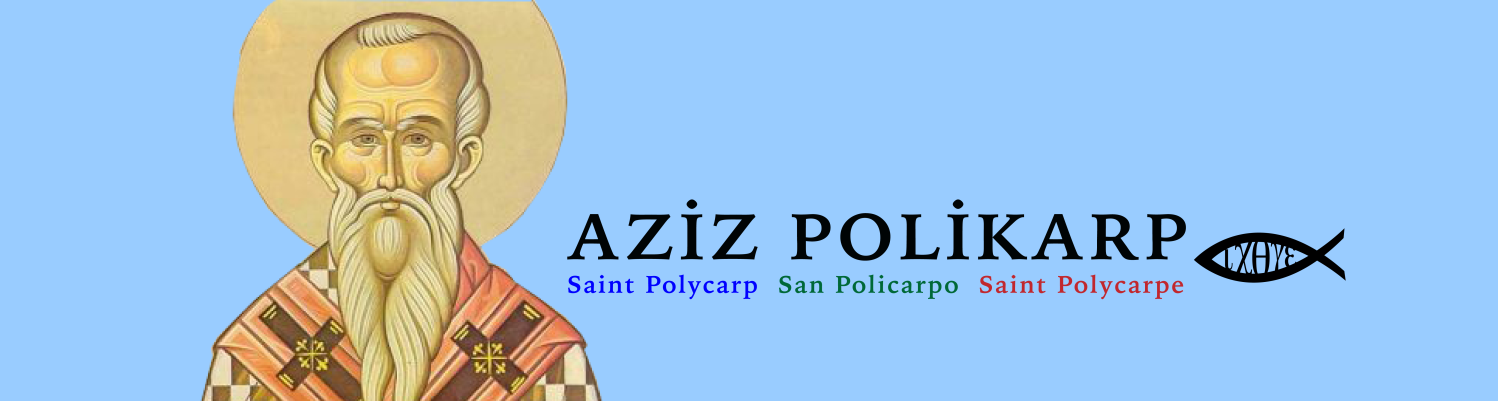
Letter from the Church of Smyrna about the Martyrdom of St Polycarp
After the pyre had been prepared, Polycarp took off his clothes himself, undid his belt and took off his shoes without anyone’s help. He had never done this before, because his followers would race to touch his body. Even before he was martyred for his faith, his noble life had always aroused deep respect.
They immediately placed the materials prepared for the pyre around him. As his executioners were preparing to nail him, he said: ‘Leave me thus. He who gave me the strength to withstand the fire will enable me to stand upright on the pyre without your nails.’ So they did not nail him, but only bound him. Thus, with his hands bound behind his back, he resembled a choice ram, drawn out of a great flock to be sacrificed, and offered to God’s favour. And lifting up his eyes to heaven, he said: ‘Lord God, whom thou lovest and hast blessed, Father of thy Son Jesus Christ, who taught us thy name, God Almighty, God of the angels, and of the powers in heaven, and of all creation, and of all the righteous generation that dwelleth in thy presence, I thank thee, because thou hast made me worthy of this day and hour, that in the company of the martyrs thou hast made me a partaker of the sufferings of Christ, that I may awake to eternal life, body and soul, through the immortality granted by the Holy Spirit. I beseech Thee, O true and only God, to appear before Thee this day with them, as Thou hast prepared beforehand, as Thou hast shown beforehand, as Thou hast performed beforehand, as a plentiful sacrifice pleasing to Thee.
And I thank Thee in all things, I praise Thee, I sing praises to Thee, I praise Thee through Thy beloved Son, Jesus Christ, the great and everlasting heavenly seer. Thanks be to Thee, and to Him, and to the Holy Spirit, now and for ever.’
When He had finished His prayer, saying Amen and lifting Him up to heaven, the fire-makers ignited the pyre.
A great flame rose up, and we who had been chosen to communicate these events to the people, and who were privileged to see them, witnessed a miracle. The fire, like a sail swelling in the wind, took the shape of a dome, like a bulwark, encircling the body of the martyr. The saint stood in the centre, not like a burning body, but like bread being baked, or gold or silver shining in a crucible. And we could smell an odour, as if from a calendula or some other expensive geranium.
Concerning the Martyrdom of St. Polycarp, a Letter from the Church of Izmir