“May I never boast except in the cross of our Lord Jesus Christ, through which the world has been crucified to me, and I to the world. For neither does circumcision mean anything, nor does uncircumcision, but only a new creation” (Gal. 6:14-15).
The Stigmata of St. Francis, which marks its 800th anniversary this year, symbolizes the ultimate identification with Christ’s suffering and love. It was a divine seal on Francis’ life of radical poverty, humility, and devotion to Christ.
From his conversion, St. Francis desired to conform his entire life to Jesus Christ. No longer happy with his own pursuits of success, Francis embraced poverty, renouncing his wealth and status to live as a beggar, serving the poorest of the poor. His humility led him to see himself as “the least of the brothers” and a “lesser brother,” titles he used to describe his role in the community he founded. Despite the miraculous nature of the Stigmata, Francis never saw it as a cause for personal pride; rather, it deepened his humility, as he viewed himself as unworthy of such a grace.
On two separate occasions, St. Francis had a vision of Jesus, wounded in hands, feet and side, suffering on the cross. If we look carefully at the two visions we will see them as closely interrelated. Both visions are described in St. Bonaventure’s Life of St. Francis.
The first vision happened to St. Francis shortly after his conversion from what he calls worldly life. Bonaventure tells us: “One day, while St. Francis was praying in a secluded spot and became totally absorbed in God through his extreme fervour, Jesus Christ appeared to him on the cross. St. Francis’ soul melted at the sight, and the memory of Christ’s passion was so impressed on the innermost recesses of his heart that from that hour, whenever Christ’s crucifixion came to mind, he could scarcely contain his tears and sighs.” Bonaventure points out that from that time on St. Francis began “rendering humble service to lepers with human concern and devoted kindness…. He visited their houses frequently, and generously distributed alms to them and with great compassion kissed their hands and their faces.”
St. Francis’ Vision on Mount La Verna
About two years before his death, St. Francis had a second vision of Christ on the cross. Here is how St. Bonaventure sets the scene in his Life of St. Francis: “On a certain morning about the Feast of the Exaltation of the Cross [September 14], while Francis was praying on the mountainside, he saw a Seraph with six fiery and shining wings descend from the height of heaven. And when in swift flight the Seraph had reached a spot in the air near the man of God, there appeared between the wings the figure of a man crucified, with his hands and feet extended in the form of a cross and fastened to a cross. Two of the wings were lifted above his head, two were extended for flight and two covered his whole body.
St. Francis of Assisi revealed the great love burning in his heart, the love which made him resemble his Beloved, the Crucified: “I bear the marks of Jesus on my body” (Gal 6:17). St. Paul’s words were wondrously fulfilled in him, and La Verna witnessed it 800 years ago and since then the world continue to venerate him of the inspiration he is of love, peace and integrity.
St. Francis embraced whole truth of Gospel paradox
The stigmata, the scars of Christ’s passion on Francis’ body, were the special sign which revealed the cross that he took up every day, in the most literal sense of the word. The Gospel was his daily bread. He did not confine himself to reading its words, but through the expressions of the revealed text he set out to discover the One who is the Gospel itself.
By his life Francis proclaimed and continues to proclaim today the saving word of the Gospel. Through him Christ wanted to proclaim the Gospel not only to his era but to others as well, to our own age, to cultures and civilizations very different from one another.
The stigmata which Francis received at La Verna, are the deepest witness of the Poverello’s truth. We are presented with him who authentically and profoundly “boasted of the cross of our Lord Jesus Christ” (cf. Gal 6:14).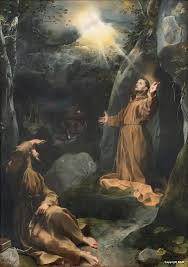
The Apostle Paul says, and St. Francis of Assisi repeats it: through Christ’s cross and the power of love “the world has been crucified to me, and I to the world” (Gal 6:14).
The world does not want to be crucified: it flees the cross. People run away from being “crucified to the world“. That is how it was in Francis’ day, and it still is today. The struggle between the “world” and the cross goes on forever; it is struggle between choices one is confronted with at every step of life. At times we are so immersed in the world, we also want to be masters of ourselves and the world. This is why Francis’ message seems an even greater sign of contradiction, yet it is increasingly sought after.
St. Francis strove to imitate Christ by self-denial
It is a message which is a pressing call to return to Christ, to rediscover in his cross “the path and the flame of truth” (St. Bonaventure, the triple way III, 5): the truth which makes us free because it makes us disciples of the divine Master.
St. Francis’ spiritual journey was marked by this faithful following of the Jesus Christ, whom he strove to imitate without reserve in self-denial and total self-emptying (cf. Phil 2:7). This journey and following of Jesus, his Lord and Savor reached its climax on La Verna with the imprinting of the stigmata. That moment, even in the agony of his flesh, was his proclamation of victory, like what St. Paul referred as “I bear the marks of Jesus on my body” (Gal 6:17).
The stigmatization on La Verna thus represents that visible conformity to the image of Christ which makes Francis the example to which every Christian aspire in the process of drawing ever nearer to God the Creator and Redeemer. In this regard the words spoken by the Poverello at the end of his life are significant: “I have done my duty; may Christ teach you yours” (St. Bonaventure, Legenda major XIV, 3).
These words do not represent a self-satisfying reflection, rather an offering of humble gratitude for what the Lord had done in him. Their meaning is nothing other than this: may Christ teach you, as he taught me, to be his disciples.
Love alone can prevent the failure of humanity
The cross has rooted him in human history; it has rooted him in human hearts.
“The word crucified” in Christ is always revealed anew as “the word loved”: “For God so loved the world that he gave his only Son” (Jn 3:16). St. Francis bore witness to this boundless love and continues to do so even in our days. Love alone can prevent the failure of humanity and the world: that world by which man is “besieged” and threatened in various ways. 800 anniversary of the Rule, Stigmata and the Canticle of Brother Sun empowers us in Christ and strengthened us once again in the conviction that love is greater than every negative power.
The life of St Francis was a life lived entrusted to the divine will. It was a life that sought nothing for itself but only how best that life might reflect the Author of all life, and most especially the life of the one through whom all life comes to be, Jesus, the Incarnate Son of God. The stigmata is the divine seal on a life lived in the pursuit of holiness and goodness, on a life that struggled for such Christ-likeness, on a life that sought nothing for itself, not even its successes, and sought always and everywhere only to be a poor, humble and brother to all that came to him and all he welcomed, including all creatures as brothers and sisters.
The story of the Stigmata does not end with St. Francis receiving personal consolation from Jesus, which took the form of the Stigmata. When he received this gift, St. Francis more fully recognized that he was being drawn more deeply into the mystery of God’s willingness to suffer with all who and that God had created. The wounds of Christ are the wounds of humanity and creation. We, like St. Francis, are invited to enter into this great feast not only to be spiritually consoled but in order to be transformed into agents of the ‘new creation’, messengers of love, universal fraternity, and restoration. Like St. Francis, we come to prayer in front of the Cross to be healed and re-energized. We come in order that we might once again have the courage to take up the cross in our daily lives, a cross that bears the sufferings of all of our brothers and sisters everywhere in the world and those of the created universe. Only those willing to undertake this difficult journey into the darkness and pain confronting humanity and the natural environment will experience the fullness of grace St. Francis experienced when he was marked by the wounds of Christ.
As we commemorate the Stigmata, we are reminded that it is not merely about the miraculous wounds; it is about the interior transformation that leads to union with Christ. St. Francis’ humility allowed him to empty himself, making room for the fullness of Christ’s presence. The Stigmata serves as a powerful reminder that true spirituality is found in surrender and self-giving, reflecting St. Paul’s words: “I have been crucified with Christ; and it is no longer I who live, but Christ who lives in me” (Galatians 2:20).
Pope Francis recalls the 800th anniversary of the stigmata of St. Francis of Assisi, and noted that every Christian has the duty to care for all the “stigmatized” people they meet who bear the “scars of suffering and injustice and he urges whole humanity to show love and compassion for our wounded mother earth.
Fr. Robert Pascal OFM
Homily in Istanbul
September 17th 24,
800th anniversary of the Stigmata of St. Francis